French press and pour-over can begin with the same beans, water and kitchen counter yet produce cups that feel surprisingly different. One keeps more texture and coffee oils in the drink. The other uses controlled flow and filtration to emphasize separation between flavors.
The better method is not the one with the more impressive technique. It is the one whose flavor, cleanup, capacity and level of attention fit your normal morning.
Two methods with different personalities
French press favors immersion and texture
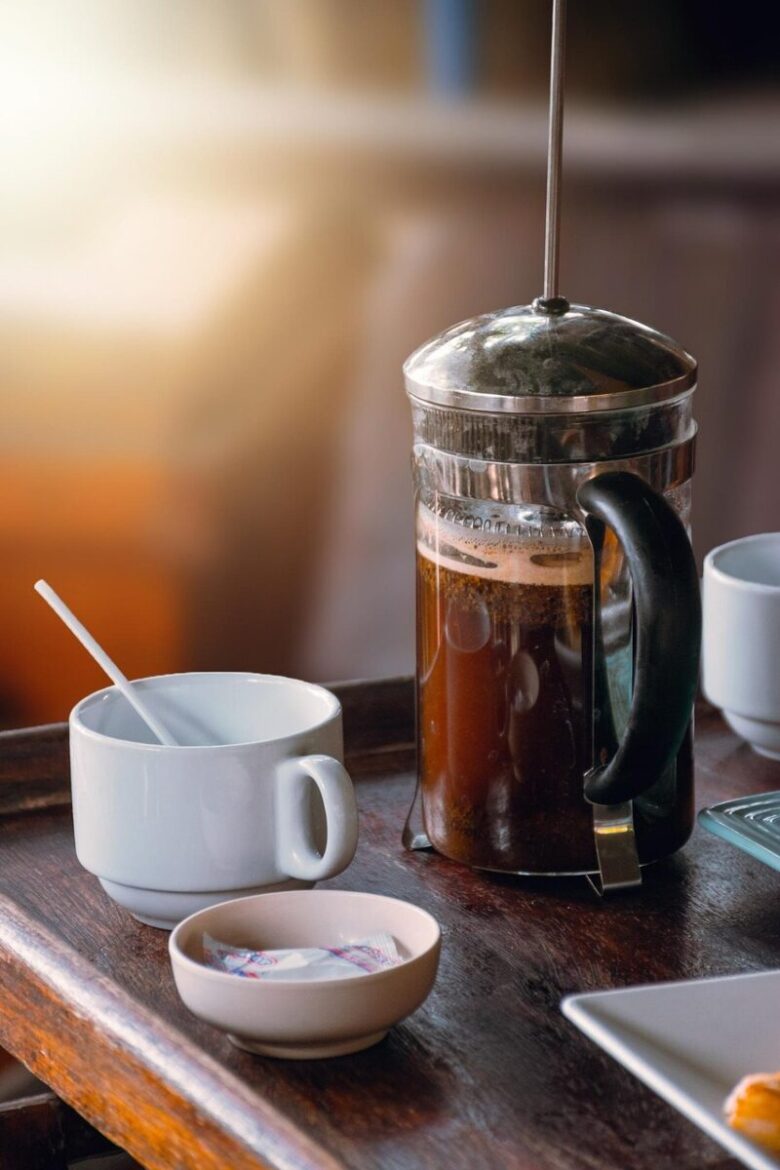
Coffee grounds remain surrounded by water during the steep. When brewing is complete, a mesh plunger separates most of the grounds from the liquid without creating the same level of filtration as paper.
The result commonly feels fuller and heavier, with more suspended fine particles and oils. It is well suited to people who enjoy body, darker flavor and the ability to make several servings with little active pouring.
Pour-over favors flow and clarity
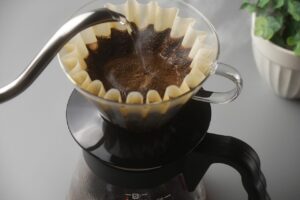
Water is poured onto a bed of coffee and moves through it under gravity. The brewer controls how quickly water is added, where it lands and how long the complete drawdown takes.
With a paper filter, the cup usually feels cleaner and lighter because more oils and fine particles remain behind. It suits people who enjoy delicate aromas, visible acidity and the small ritual of making one controlled cup.
Immersion and percolation change the brewer’s job
All the coffee steeps together
Once the grounds are saturated, most of the extraction occurs while coffee and water remain in the same chamber. Timing matters, but the brewer does not need to maintain a pouring pattern throughout the process.
This makes the method comparatively forgiving of hand movement. The main controls are grind size, ratio, water temperature, steep time and how quickly the brewed coffee is poured away from the grounds.
Fresh water continuously moves through the bed
The extraction develops as water enters the top, travels through the particles and leaves through the filter. Grind size, pouring speed, agitation and brewer geometry all influence this flow.
The method offers more direct control, but it also makes uneven pouring and channeling more visible. A repeatable recipe is easier to achieve with a scale and a kettle that pours predictably.
The practical comparison
| Decision point | French press | Pour-over | What it means at home |
|---|---|---|---|
| Cup texture | Fuller, heavier and sometimes slightly silty | Cleaner, lighter and more transparent | Texture preference may decide the choice before any technical detail. |
| Flavor presentation | Blends aroma, body and roast character into a broad impression | Often makes individual fruit, floral and acidity notes easier to separate | Neither is inherently more flavorful; they organize flavor differently. |
| Grind starting point | Medium-coarse to coarse | Usually medium, adjusted to brewer and batch size | An adjustable burr grinder makes either method easier to repeat. |
| Active attention | Low after the water is added | Higher during blooming and the main pours | French press frees several minutes; pour-over turns those minutes into a ritual. |
| Typical brew duration | Around four minutes of steeping | Commonly about two to four minutes of water contact | Total kitchen time also includes heating, grinding and cleanup. |
| Batch size | Convenient for multiple servings when the press has suitable capacity | Often optimized for one or two cups, although larger brewers exist | Match the equipment size to the amount normally prepared. |
| Filter cost | Reusable built-in metal mesh | Paper filters must normally be replaced, unless cloth or metal is used | Pour-over has a small recurring supply cost. |
| Cleanup | Wet grounds must be removed from the carafe and mesh | A paper filter can usually be lifted out with the grounds | Pour-over often wins when fast disposal matters. |
| Portability | Simple, but glass models can be fragile and bulky | Compact plastic or metal drippers travel easily | Both still require a grinder, hot water and a way to measure the recipe. |
Let your morning routine make the decision
Add the water, start the timer and prepare breakfast while the coffee steeps. A suitably sized press can produce several servings without repeating the complete process.
The method asks for several minutes of attention, but that attention can be part of the appeal. It is especially useful when you want to explore one coffee and notice how its aroma changes as it cools.
Begin with French press when you like heavier coffee or usually add milk. Begin with pour-over when you prefer a clean cup or want to explore lightly roasted, single-origin coffees.
Why the cups feel so different
The filter is one of the clearest differences. A French press typically uses a metal mesh that allows more coffee oils and very small particles to remain in the beverage. This contributes to body but may also leave sediment near the bottom of the cup.
Paper-filtered pour-over retains more oils and fine material. The resulting drink can make acidity and aromatic details feel more distinct because the texture is lighter.
- French press does not automatically mean stronger coffee.
- Pour-over does not automatically mean weaker coffee.
- Strength is strongly influenced by the coffee-to-water ratio.
- Extraction is influenced by grind, temperature, time and water movement.
Two reliable starting recipes
These recipes use the same 1:16.7 coffee-to-water ratio so that the main differences come from filtration and brewing style. Adjust by taste after establishing a repeatable baseline.
- Preheat the press, then discard the warming water.
- Add 18 g of medium-coarse coffee.
- Pour 300 g of water near 93°C, fully wetting the grounds.
- Place the lid on without pressing the plunger.
- At approximately four minutes, press slowly and evenly.
- Pour all brewed coffee into cups or another vessel rather than leaving it on the grounds.
- Place and rinse the correct paper filter, then discard the rinse water.
- Add 18 g of medium-ground coffee and level the bed gently.
- Use 300 g of water near 93°C.
- Begin with a 45–55 g bloom and wait approximately 30–45 seconds.
- Add the remaining water in a controlled stream suited to the brewer.
- Use a total drawdown near two and a half to four minutes as an initial diagnostic range.
Problems that belong to each method
Grind coarser, use a more consistent burr grinder and press gently. Stop pouring before the final sediment-heavy liquid enters the cup.
Pour the full brew away from the grounds after pressing. Leaving coffee in the press allows continued contact and can change the later cups.
Do not force it. The grind may be too fine, the basket may be overloaded or particles may be blocking the mesh.
Try a slightly finer grind and confirm that the filter fits correctly. Keep the dose, water and pouring structure unchanged for the comparison.
Grind slightly coarser or reduce excessive agitation. Very fine particles can migrate downward and restrict the filter.
Weigh each pour, use a consistent kettle position and simplify the recipe. Several small pulses are not automatically better than one controlled structure.
Cleanup, waste and recurring cost
No disposable paper is required, but wet grounds can be awkward to remove. Use a spatula or add a little water and empty the grounds according to local compost or waste practices rather than washing a large quantity into the drain.
Grounds and filter can usually be lifted together, making cleanup fast. The tradeoff is a continuing need to purchase correctly sized filters.
Metal and cloth reduce disposable-filter use but change texture and require thorough cleaning. A metal dripper may move the cup closer to French press body.
Taste the difference without reading the labels
A side-by-side comparison is more useful than trying each method several weeks apart. Use the same beans, water and ratio, then ask another person to serve the cups without identifying them.
Do not force identical grind sizes. Use a medium-coarse grind for the press and a medium grind for the pour-over so each method can operate normally.
| Observation | Cup A | Cup B |
|---|---|---|
| Body from 1 to 5 | ||
| Flavor clarity from 1 to 5 | ||
| Sweetness from 1 to 5 | ||
| Sediment noticed | ||
| Main aroma or flavor | ||
| Would you make it on a weekday? |
Which method fits your routine?
Answer all five questions. The result reflects routine and texture preferences rather than ranking coffee quality.
Which method makes stronger coffee?
Which method has more caffeine?
Can light-roasted coffee be brewed in a French press?
Do I need a gooseneck kettle?
There is no reason to stay loyal to only one
French press works well when several people want a rich cup and nobody wants to stand over a dripper. Pour-over makes more sense when one coffee deserves focused attention and a cleaner presentation.
A household can use the press during busy mornings and the dripper on slower weekends. The two devices are inexpensive compared with most coffee machines and occupy different roles rather than replacing each other completely.
Choose the method whose inconvenience you mind less. French press asks you to accept sediment and messier grounds. Pour-over asks you to accept active pouring and a supply of filters. The flavor advantage follows the routine you are willing to repeat.
Brewing and filtration references
- National Coffee Association — French Press Coffee . Official brewing overview covering immersion, equipment, capacity, temperature, grind and full-bodied texture.
- National Coffee Association — Pour-Over Coffee . Official guide covering filter types, kettle control, brewing ratio, temperature, contact time and pour-over technique.
- Specialty Coffee Association — Guidelines for Brewing with a Three-Cup French Press . Technical reference using a medium-coarse grind, approximately 93.5°C water and a four-minute brewing time.
- PubMed — Investigation of Eight Coffee Extraction Methods . Peer-reviewed comparison showing that brewing method changes the physical and chemical composition of prepared coffee.
- PubMed — Paper Filters and Cafestol Content in Filter Coffee . Peer-reviewed research examining how paper-filter characteristics influence coffee diterpene retention.
The external references above were active and accessible during this editorial review. Brewing ratios, temperatures and times are starting points; grinder performance, brewer geometry, roast and personal preference may require adjustment.
The Bruxa Coffee editorial team creates practical guides, brewing resources and interactive coffee tools designed to help readers brew better coffee at home. Our content focuses on clear explanations, reliable information and hands-on brewing knowledge for coffee enthusiasts of all experience levels.